Tanabata: Japan's Star Festival, Three Cities, Three Ways
On the seventh night of the seventh month, two stars meet above Japan. Everything else is up for debate.
Tanabata — Japan's star festival — is built on one of the oldest love stories in East Asia: a weaver goddess and a cowherd, separated across the Milky Way, allowed to cross to each other just once a year. The story arrived from China in the 8th century, fused with an older Japanese ritual, and eventually became something every child in Japan grows up writing wishes on paper strips for. That much is consistent. What the festival actually looks like on the ground is another matter entirely.
In Sendai, the streets vanish each August under ten-meter columns of handmade washi paper and silk, the result of months of work, each design kept secret until the morning it goes up. In Hiratsuka, an hour south of Tokyo, shopping arcades fill in early July with illuminated vinyl figures of that year's sports heroes and anime characters, glowing after dark. In Kyoto, a priest makes offerings at a mountain shrine to the water deity while a musician performs classical court music beside a river — and most of the city has no idea it is happening because Gion Matsuri is going on at the same time, and Gion Matsuri is the kind of thing that makes everything else invisible.
Same festival. Completely different Japan.

Image courtesy of the Sendai Chamber of Commerce and Industry.
Tanabata in Sendai: Japan's Largest Star Festival
Sendai's Tanabata is the one everyone copies. Hiratsuka modeled itself on Sendai. Dozens of smaller festivals across Japan did the same. The original, running each August, remains the largest and the most specific about what it demands.
Every decoration in Sendai must carry seven ornaments — the nanatsu kazari — each one traceable to the original court ritual that Tanabata grew from. Paper strips for scholarship. A paper kimono as a stand-in for illness and misfortune, absorbing what it can before it is discarded. Folded cranes in a number matching the age of the household's eldest member. A drawstring pouch for prosperity. A casting net for good harvest and fishing. A small basket woven from paper scraps, a quiet argument for wasting nothing. And the fukinagashi: long silk streamers representing the five colored threads once offered to the weaver star, which is where the whole story began.
The fukinagashi is what stops people. Five streamers hang from a globe called a kusudama at the top of each bamboo pole, several meters long, designed to turn in the August wind. One set takes months to make. There are roughly 3,000 of them across the central arcades. The designs are kept secret until the morning they go up, judged the same afternoon, gold and silver and bronze awarded by evening. Arriving early means watching the bamboo raised for the first time. It is the kind of thing that does not photograph the way it feels.
The festival nearly ended in 1939 when the war made spectacle impossible. It came back in August 1946 with 52 poles along the Ichibancho arcade. When the Showa Emperor visited the following year, 5,000 lined his route. Over a million people now come each August — which is a long way from what it was when it started, a city putting decorations back in the street to remind itself it was still there.

Image courtesy of the Shonan Hiratsuka Tanabata Festival Executive Committee.
Tanabata in Hiratsuka: The Star Festival That Reinvented Itself
Hiratsuka in July 1945 was largely destroyed. Air raids burned roughly 70 percent of the city center. Six years later, the local chamber of commerce launched its first Tanabata festival, looking to Sendai for a model.
The resemblance faded almost immediately.
With no tradition of its own to honor, Hiratsuka's merchants were free to make whatever drew a crowd. What drew a crowd was the present tense: decorations built around that year's cultural moment, oversized, lit from inside, changed annually. The athlete of the season. The anime character everyone was watching. The story dominating the news. Nothing fixed, nothing obligatory, nothing that could not be replaced next year by something more current.
When the rainy season made washi paper impractical, they switched to vinyl. When vinyl allowed for electric lighting, they used it. Hiratsuka after dark in July became something Sendai, faithful to its handmade silk and paper, has never tried to compete with.
Three million people come each year. Researchers who have compared the two festivals note that Sendai's seven-ornament convention produced objects of genuine craft while Hiratsuka's freedom from convention produced something closer to an annual campaign — impossible to ignore, designed to be replaced.

Image courtesy of the Kyoto City Tourism Association.
Tanabata in Kyoto: The Quietest and Oldest Version
Kyoto in July belongs to Gion Matsuri. The procession of lacquered floats through the city on July 17 is a thousand-year-old event that absorbs the city's full attention, which is one reason Tanabata here never became a spectacle. It did not need to compete. It simply continued.
At Kifune Shrine, forty minutes by train and foot from central Kyoto, July 7 is the Water Festival. The shrine sits in a cedar valley above a mountain river and enshrines Takaokami no Kami, the water deity — a connection to Tanabata that predates the weaver story, rooted in an older Japanese cosmology that understood the Milky Way as a river before it became a metaphor for longing. The ceremony on July 7 includes a formal tea service by the Urasenke school, classical court music performed beside the water, and a ritual food preparation by a master of one of the oldest culinary traditions in Japan. It is not a public performance. It is a religious observance that happens to take place somewhere a visitor can reach.
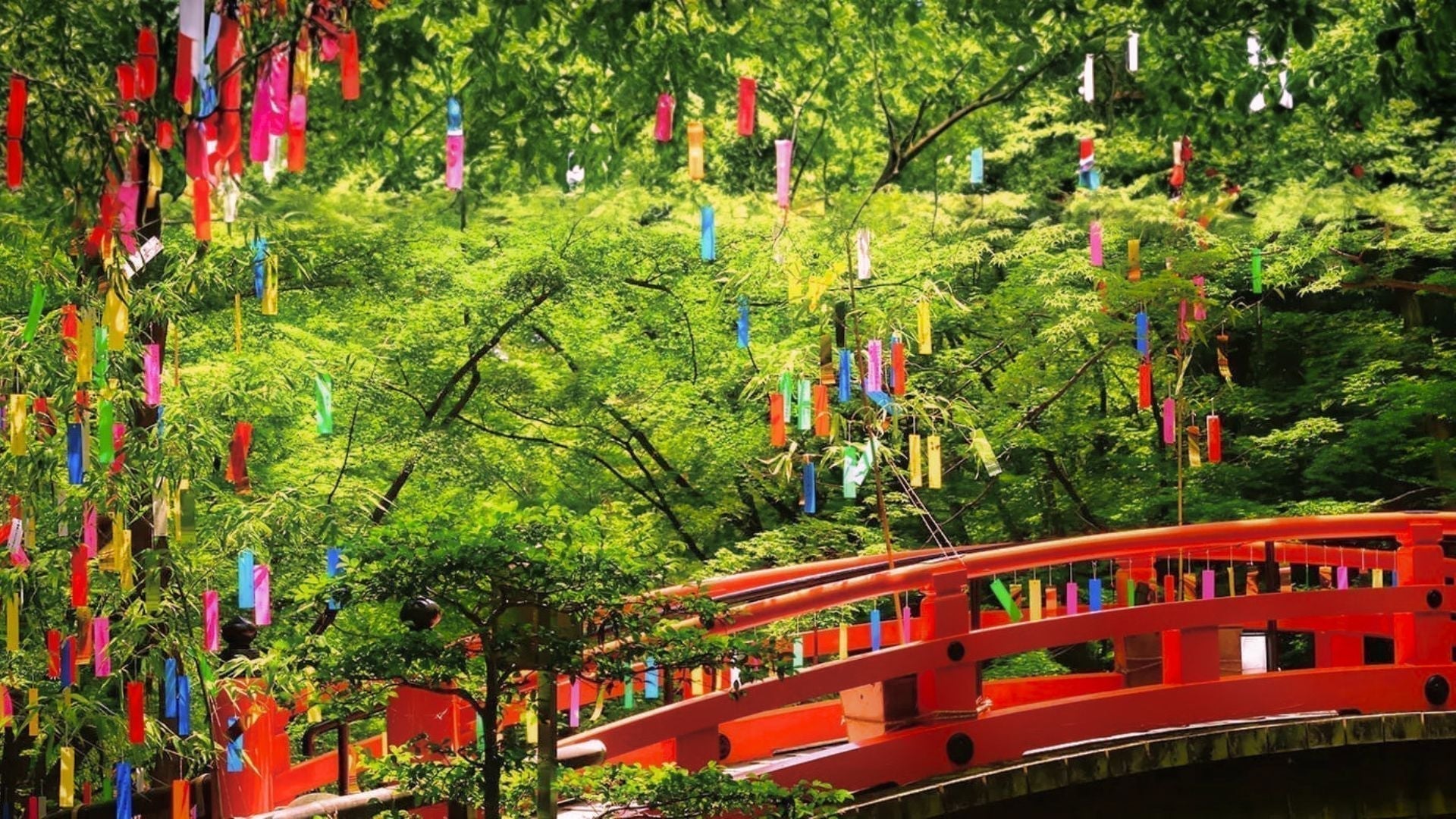
Through mid-August, the shrine is lit from sunset: stone lanterns along the stairway, bamboo hung with paper wishes, the forest going dark behind the main hall. The path from the station passes restaurants extending their dining rooms over the river on wooden platforms — kawadoko, a summer custom that belongs to this valley specifically and nowhere else.
In August, on the old lunar calendar, the city runs “Kyo no Tanabata”: Yuzen fabric dyeing on the Kamo River, light installations along the Horikawa canal, evening events at Nijo Castle. Kyoto is where the original court ceremony was practiced over a thousand years ago, and it remains Japan's center of Nishijin weaving and Kyo Yuzen dyeing. When fabric goes into the Kamo River during the festival, it is not arranged for effect. The logic has not changed since the Nara period.

The Unchanged Gesture
Three cities, one story, nothing in common beyond the paper strip and the wish. A child tying a tanzaku to bamboo in a Hiratsuka shopping arcade is doing exactly what a court poet did in the 8th century — with the same intention and roughly the same uncertainty about whether anyone above is listening. The festival changed everything about itself as it moved through time. That gesture did not.