
Kamo Hamono: The Knife, the Crisis, and the Color Only a Master Can Read
The master smiths at Kamo Hamono don’t check the temperature. They read it.
The textbook number is roughly 800 degrees Celsius, but the real answer is a moody, shifting shade of red that senior craftsmen recognize without a second thought. Push the steel a fraction too far into the light and the hagane—the fiercely hard cutting steel laminated into the blade—simply burns away. The metal is inherently stubborn: it stretches differently by season, meaning a hammer strike that draws it out cleanly in May won't yield the same result in August. Every blade demands a silent, ongoing correction by eye. Repeated over a lifetime, that precise instinct is the actual luxury barrier between a hand-forged masterpiece and a machine-pressed blade.

The History of Echizen Uchihamono and Hand-Forged Cutlery
Blademaking in this corner of Fukui Prefecture has been a hyper-focused obsession since 1337, when a Kyoto swordsmith named Chiyozuru Kuniyasu came looking for the right water to temper steel. Almost as a side hustle, he began forging sickles for local farmers.
The sickles outlasted everything. By 1979, Echizen became the first knife-producing region in Japan to receive the government's traditional craft designation—a badge of honor built on the principle that the material must be deeply understood, not just processed through hizukuri (shaping steel step by step, hammer strike by hammer strike).

Why the Hizukuri Forging Method Matters for the Finished Knife
But the real high-stakes drama happens far from the forge. At the grinding wheel, the final sharpening introduces a breathless kind of pressure. Because every blade is forged by hand, two knives from the same line emerge with slightly different dimensions.
The sharpener has to feel that microscopic variation with his fingertips rather than measure it. Drop the heel or the tip even a fraction of a millimeter at this final stage, and the knife is finished—not in the sense of completion, but of absolute ruin.

The Market Shift That Challenged Traditional Echizen Knives
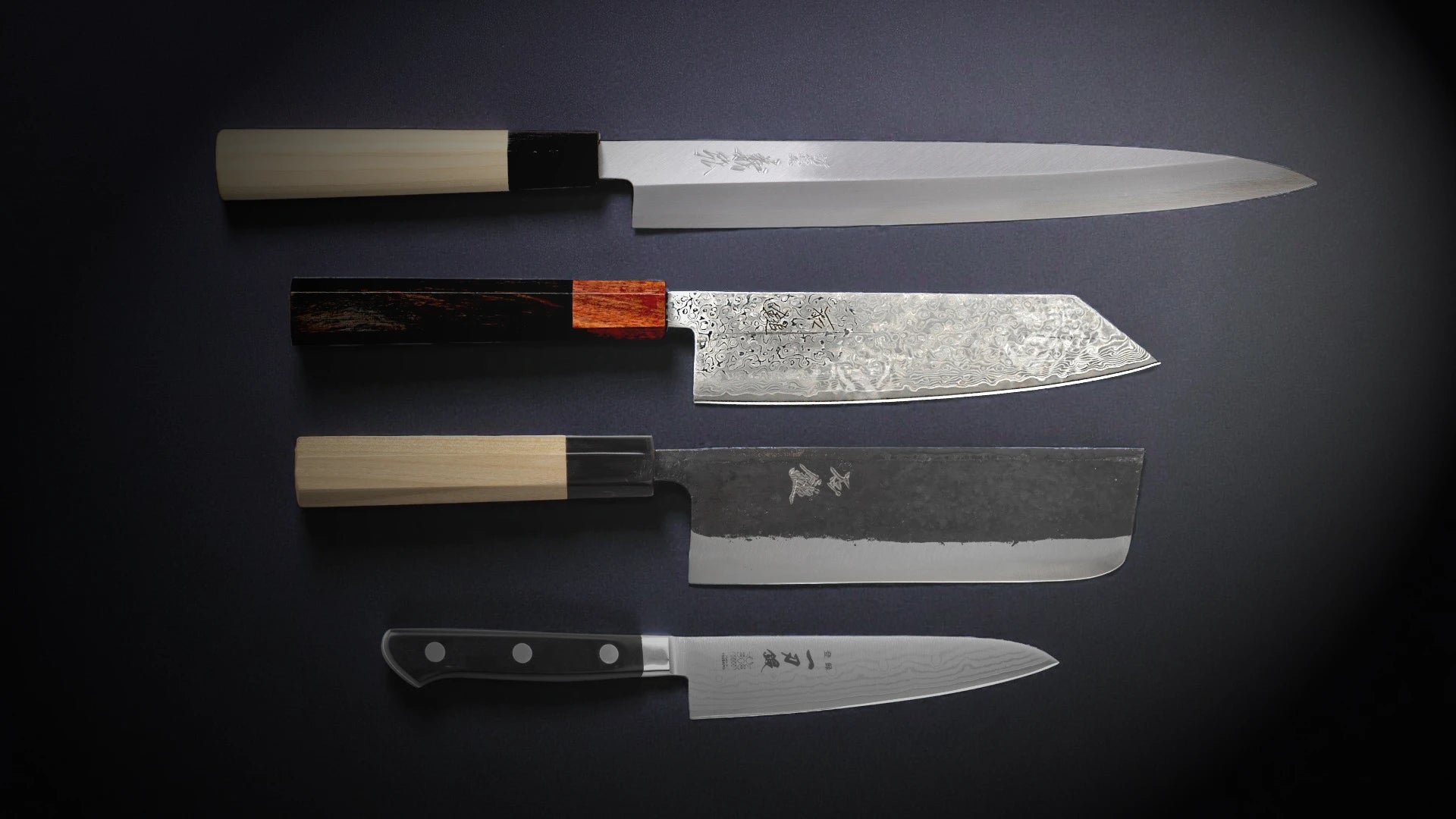
Katsuyasu Kamo remembers when a single, unvarying style was enough to satisfy the market. For generations, the heavy, rustic nakiri-bōchō—a vegetable knife that proudly rusts and darkens with use—kept the town fed.
Then the culinary landscape shifted. Makers from Seki, in neighboring Gifu Prefecture—a region world-renowned for its own brilliant swordmaking legacy and peerless precision engineering—began capturing the market's attention. Leveraging advanced production methods and flawless quality control, Seki workshops produced sleek, incredibly uniform knives that offered remarkable performance and accessibility. They answered a new modern demand: chefs wanted pristine consistency right out of the box. Echizen’s traditional virtues—the rugged individuality of hand-forging—faced an entirely new vocabulary of consumer expectations, and orders collapsed. "What now, what now," Kamo recalls of that pivotal survival crisis.

How Kamo Hamono and Takefu Knife Village Saved a Regional Craft
The turnaround began when Kamo partnered with industrial designer Kazuo Kawasaki to develop new stainless steel lines. They kept the traditional forging foundation but wrapped it in a sleek, minimalist aesthetic the changed market could actually read. They carried the results to Tokyo, where high-end chefs and executives gave a verdict based entirely on performance, not nostalgia.
"We built this workshop out of that sense of crisis," Kamo says. "Seven hundred years of history. We weren't going to let that disappear."
In 1991, Kamo united the region's younger successors to found the Takefu Knife Village cooperative, serving as its first chairman. More than a dozen independent families gained a shared, cutting-edge facility instead of disappearing separately. Kamo Hamono’s response to its near-collapse became the very framework that saved the entire region, turning Echizen knives into a global status symbol.

What the Next Generation of Kamo Hamono Is Building
Today, the workshop is changing shape again from within. A gradual handover to a new generation has produced a line developed through the F-TRAD initiative, built on the concept of oyako bōchō—a parent-child knife.
The architecture of the blade has been completely re-engineered: the spine is thicker, the edge is ground thinner, and the tang geometry is entirely different from Kamo's original work. Armed with an expanded library of modern steel alloys, every young craftsman in the shop has arrived at his own sharp sense of design.
Asked what quality he is chasing in these new, avant-garde pieces, the younger smith gives the shortest possible answer:
"Thinner. Stronger."
Back in the darkness of the forge, the master smiths are still reading the exact same shade of red. Seven hundred years is not a promise or a guarantee. It is, at best, a record of how many times a crisis has arrived at the workshop door, and how many times someone inside found the presence of mind to evolve. Everything built on top of that fire changes, but the silent correction made by a human eye remains the one thing that doesn't need to.


